Showing posts with label politics. Show all posts

Sunday, July 31, 2016

Made in New York, or Go Home, Greenpeace, You're Drunk

For the first time ever, I got to visit an honest-to-goodness New York City garment factory! With all the talking and teaching about garment industry that I do, it was long overdue.

The factory, Johnny's Studio, manufactures clothing for SCHAI, among others, and it is thanks to SCHAI's founder and designer, Suk Chai, that I got to visit. And to meet Suk, who is smart and funny and gracious, and took time to show me around.

It was amazing to see this vibrant life, mere remnant of the volume of 1950s and 1960s, but so much is the same: the skill and the energy, and the industry that still seems to function (although on a smaller scale) as an engine for getting immigrant workers to middle class and business ownership. The garmentos of yore, the Italian and Jewish workforce of the early days, seem to have been supplanted by Asian and Latinx/Hispanic owners and workers, but the vibe is still there! (Has anyone read The Beatiful Generation by Thuy Linh Nguyen Tu, by the way? It's great, and talks at length about the link between Asian-American fashion designers and Asian workers in the garment industry. Anyway, I babble).

Here are some pics!


(I was told Ken here was cutting my dress!)

Here's a snapshot of a few of SCHAI's Fall looks, by the way. As you probably guessed, it's yet another obsession.


I mean, look at these pants!


As you can guess, I love this label not just because of the tailoring and luxe drape of the textiles, but also because it is domestically made, uses well-sourced, high quality fabrics, and doesn't cut any manufacturing corners. The price point of course reflects this ethos. Which is just another way of saying this: there is no way on earth to make cheap garments sustainable. Of course higher price alone does not guarantee sustainability (in fact, many well-known brands' pricetags reflect little but name recognition), but the opposite is certainly true: a ten dollar dress is inherently problematic. Not only because of the impossibility of paying living wages and buying decent materials with that kind of retail, but also because cheap clothes are disposable, and they will be choking our landfills with their poly blends for centuries to come.

And this is why this Greenpeace -authored rundown is especially puzzling. The criteria are so ridiculously narrow as to completely ignore the irreducible reality of how clothes, physical garments, affect the environment in many complex and intertwining ways, and of which toxic compounds are only one part. H&M and other fast-fashion retailers are a problem, and will continue to be so as long as they continue the current volume of production at current prices, no matter how many toxic chemicals they ban.


Tuesday, September 23, 2014

Luxe Fabrics and Political Choices

The quality of air is different in the fall -- the temperatures that would feel balmy in July are downright brisk in September. Either that, or I am deluding myself in order to wear wool when it's almost seventy degrees outside.

Merino wool, to be exact -- this COS lightweight top is a dream, in a warm beige and luxurious drape, and the pleated sleeves give it a distinct yet subdued character. 


The skirt, however, is the real showpiece here: it is by Litkovskaya, a Ukranian designer, and I recently bought it from Suitster.com, one of my favorite online stores. The material is a substantial, stiff silk, almost taffeta-like in quality but with a rough finish that feels a bit like wool. (Another reason I like overseas shopping is the variety of quality natural textiles, especially silks. Silks in the US market seem to be largely dominated by chiffon and charmeuse, with some washed silk thrown in for good measure. While I enjoy all of those, I also seek out heavier weights and raw silks; so far, Suitster and VanHongo are my go-tos for those.)


And the side view, showing the intricate pleating of the skirt, and the side sweep of the hem. It is quite architectural, and cleverly constructed: the closure is via hidden snaps in front, which allows the skirt to move well despite the rigid fabric. I chose Rachel Comey shoes with wooden heels here because they seemed to work with yet against the more dressy elements. They also played well with driftwood of my reading chair!


The necklace is from Luv AJx JewelMint collection, and it is lovely. Here's its closeup (and my fresh manicure).


And there is also another thing. Shopping and clothes are frivolous, no doubt. But, as any social institution, it matters in that affects our lives as well as lives of those who make the clothes and run the shops. I became interested in fashion as an extension of my fascination with social movements, and specifically the intimate connection between the US garment industry and labor union and suffrage movements in the early 20th century. But even today, manufacturing and distribution of clothing are deeply connected to the social institutions and political climates, and one cannot escape being enmeshed in politics of it all. And I really get that sometimes one doesn't feel like dealing with the complexities; sometimes, high street (like that lovely COS top above) is just fine.

But sometimes, I want to consider what economies are being supported with my spending. And this is when I shop small, local, indie, etc. And I have been making a concerted effort to support Ukrainian businesses and designers. Most of you have some knowledge of the tragedies that have befallen this beautiful country and its people lately; I am heartbroken about it. And I think people and institutions of the West too readily default to charity as a way of supporting struggling countries, with not enough attention given to investing into local economies and supporting local manufacturing. It seems to me that making economies more sustainable is quite beneficial in the long run.

So no, I won't pretend that my shopping will save the world or even solve any of its problems; but I do feel that when we decide to spend money, where and how we do so matters, and thus our choices should be considered... at least some of the time. I wouldn't expect anyone to ditch Zara just yet.

Sunday, June 16, 2013

The return of fashion blogging -- Indie designers edition, with outfit pics

As I mentioned many times, my clothes shopping has evolved toward more indie designers, with some more mainstream pieces mixed in. While I haven't entirely nixed the fast fashion, it is a very small portion of my wardrobe, mostly confined to the silhouettes I want to try but am not yet ready to fully commit to at designer prices (such as Zara sarong trousers below, which I really like, but not enough to buy the Celine version).


(I'll explain the jacket in a just a sec).

So today I wanted to talk about some indie designers, all three from New York City. I will also do a post on Ratt soon (the label created by Rita Attala, an amazing Greek-Lebanese designer), but today I wanted to focus on the closer to home -- especially since I just had a chance to visit NYC, on the day when several indie brands had a sample sale at the Textile Arts Center in Manhattan. Fashion heaven, that what it was.

I was very pleased to see Degen well-represented there. The playful and interesting knitwear by the brand founder, Lindsay Degen, has been on my radar for a while -- mostly because, as their lookbooks amply show, this is the closest I've seen a knitwear line come to embody the very nineties DIY, zine, Riot-Grrl esthetic. I did get a nice tank, in a fairly subdued white, red and gray pattern (look, I'm almost 43) for a fraction of retail price, so bonus! No pictures though.. yet. However, I found an image of my tank at Of A Kind:


The standout of the sale however was Titania Inglis -- of whom I somehow haven't heard until Friday. Titania herself was present at the sale, gracious and friendly, dressed in a gorgeous black dress that was all its own while being just a tad reminiscent of Rick Owen and Ann Demeulemeester. The edgy, almost punky geometric look of some of her other pieces was well-contrasted with softer tea-stained blouses and sharply cut pants and skirts. There was a jacket of Japanese selvage denim that caught my eye right away, and I needed little persuasion to snag that piece. (The jacket is featured in all the pictures, because I just love it.) Here's a closeup:


Needless to say, I also appreciated Titania's philosophy of using deadstock and ethically sourced fabrics, organic dyes, and local labor. Garments produced ethically are not cheap, but the reduction in environmental impact and the wardrobe size makes it worth it. I will certainly be looking at more of her pieces (maybe one of those tea-stained blouses).

Finally, The Cut has recently profiled Peggy Tan of Mandarin & General. This is a brand explicitly built on incorporating elements of traditional Chinese dress into modern western garments. Fashion industry as a whole LOVES the "exotic" and tends to be at worst appropriative and at best tone-deaf about incorporating "cultural" elements: tribal prints, Chinoiserie, "Navajo" beading etc etc -- the list goes on forever. Apart from the troubling tendency to treat traditional dress of non-Western cultures as costume, somehow separate from "Fashion" (it needs to be filtered through the eyes of the recognized designer in order to be accepted into the fashion fold, a la Duro Olowu and Nigerian prints), it is still heartening to see the interpretation done by the cultural insiders. Tan (who is from Taiwan originally) is clearly familiar with traditional Chinese dress (looking at you, Dior) and its significance and manufacture, as well as has a keen eye for the understated and yet striking.

Take for example this skirt:


It is black, flowy silk, with long slits down the sides but the panels are held together at the knee, preventing the wearer from flashing the entire leg a la Angelina Jolie. I love it when something so simple and basic as a long black silk skirt is made interesting by minimal and clever detailing. And everything is made in New York, just like Titania Inglis pieces! Seeing that on a label just makes my heart sing.

So here you have it: three cool designers, all doing different things to bring the Garment District back to its former glory. I know for sure that I will be on the lookout for the new collections by all of them.

Friday, March 15, 2013

Suzy Menkes and the Art of Sartorial Othering


So if you follow the fashion blogosphere at all, you probably noticed the splash made by a recent Suzy Menkes article, "The Circus of Fashion". Go on, read it -- it's controversy-generating, to say the least. Many fashion bloggers have responded, from The Man Repeller's Leandra Medine to Natalie Joos of Tales of Endearment.

And this is a debate worth having. The bloggers do admit the circus (or, if one is inclined to kindness, performance) aspect of the fashion week. And then it takes the turn into the well-worn rut: the "old media" complains about those damn kids who just go and start blogs with no qualifications, while the bloggers point out the democracy of the internet-based fashion coverage. We then take a swing at street style photographers and those who bait their attention, and discuss the merit of various bloggers; this is nothing new. This is the conversation we have been having for years now.

However, there are two things that rarely get mentioned: the debate is of course not so much about different forms of media or even about the old guard vs the new guard. The discussion is very much about old money and new money, the contempt the former has for the latter, and the reasons for said contempt. Because the main difference between, say, Menkes and any of the bloggers she is slugging is that Menkes is employed by NY Times, which is paying her salary. The designers might refuse her an invite to their shows should she displease them with her reviews, but neither her income nor her ability to review their collections (as Cathy Horyn aptly shows) would suffer. That's the helpful thing about the Internet: now everyone can review the collections as they hit the web in real time. But I really think that the issue of income is an important one: bloggers DO rely on sponsorships by brands, and as such, are vulnerable to retaliation. Withdrawal of sponsorships and ads, not to mention free stuff, would affect the ability of a blogger to be entirely honest in their reviews. I mean, if Cathy Horyn was a blogger, she would not have many sponsors to disclaim in her posts, if you know what I mean.

So Suzy Menkes does have a good reason to be suspicious of bloggers: many do write amazing content. And yet, fashion industry does provide their income; biting of the feeding hands is generally not a wise strategy, at least for those whose main source of income comes from the fashion industry. And yes, I am certain that most bloggers DO genuinely like the things that they review. However, negative reviews are rare in the professional blogosphere. Most of the reviews are overwhelmingly positive, and the not-so-thrilling shows, products, and shoes are merely not mentioned (just like money in polite company).

The second aspect is a lot less defensible though. The bloggers and street fashion stars that Menkes calls out almost all are either people of color or Eastern European -- two groups that tend to spoil Westerners' vacations and other moneyed pursuits. It's hard to take Menkes seriously when she complains about fashion week becoming a "circus", as she sounds very much like anonymous sources in W Magazine that wibble about Saint Tropez not being what it used to be due to an influx of "rappers, Arabs, and Russians" (direct quote). The targeting of these groups is especially obvious once Menkes compares the show-off nouveau-riche to the ever-classy and super French: Emmanuel Alt, Virginie Mouzat and Ludivine Poiblanc. The "understated chic" is presented as an inherently superior alternative to the "look at me fashion" -- the conspicuous consumption by the groups that has been denied access to luxury until very recently.

It is almost funny to see Menkes say, "It is great to see the commentaries from smart bloggers — especially those in countries like China or Russia, where there was, in the past, little possibility of sharing fashion thoughts and dreams", without apparent awareness that the very people she is chiding are mostly Russian and Asian or of Asian extraction. Basically, the previously fashion-deprived are welcome to share in the glory of fashion as long as they conduct themselves by the rules established by their betters -- French and East Coast USA fashion editors, who consider visible luxury gauche (gotta love the oh-so-Puritanical disgust of things that LOOK expensive), and who would tut-tut those newcomers for their lack of restraint and manners.

This appeal to good taste is a fascinating tactic of sartorial othering, the one that is deployed very quickly at any sign of status quo being threatened. We constantly read articles reporting how luxury goods markets are going through the roof in BRICS countries, with the authors' disapproval palpable. Even in this ostensibly post-colonial era, we know who is in charge because they are the ones who set the rules of what is and isn't in good taste, and who should and shouldn't be spending their money on Gucci sunglasses. And while I generally enjoy smart fashion coverage done by the old guard of Menkes, Horyn, and Yaeger, and I do believe that their financial non-dependence on fashion is essential to their freedom of expression, I do not relish Menkes' finger-wagging. This is a favorite tactic of the dominant group hellbent on maintaining their dominance, and that is just in bad taste.

Sunday, September 02, 2012

Today in Moral Panic


(Photo credit: www.zara.com, Zara Woman campaign featuring Freja Beha Erichsen)

So a number of news outlets ran a story about Zara -- a fast fashion chain, who is apparently not doing as well in the US as the rest of the world due to the fact that their sizes run small. That part itself isn't particularly controversial -- I am not a big Zara shopper, as I tend to avoid fast fashion in general, but occasionally I am tempted to try on an especially trendy jacket (haven't bought anything yet), and I know their sizes are actually the same as most designer versions (which tend to be almost aggressively anti-vanity sized). But compared to Gap, Banana Republic, JCrew these sizes do run small. Or, if you prefer, Gap etc have fallen victim to "vanity sizing".

I find the term "vanity sizing" very curious -- it seems to place the responsibility on the wearer rather than a manufacturer. As if it was the wearers who demanded that the manufacturers redefine their sizes to assuage their egos. This is of course not the case -- women for one didn't decide that they need to fit into the smallest size possible in a cultural vacuum. The media is saturated with references to acceptable sizes for women -- size eight, four, zero have all been touted as THE size every woman should fit into or at least get as close as possible to be socially acceptable. Without those 8s, 4s and 0s referring to a real thing (like, say, a specific measurement in inches) what is to stop the manufacturer from shifting those sizes to sell more units to women, basically luring them with promises of social acceptability IF THEY BUY THIS DRESS? Nothing, of course, and it is not the wearers and the buyers who are to blame -- it is the unrelenting pressure from the society and the basic tenet of capitalist economy: dissatisfaction will keep us buying. But yes, we still blame the victims. NB: and of course since there isn't a TRUE size 0, 2, 4 etc, since sizes are arbitrary anyway, so the whole "vanity" thing is a bit of red herring. But I'll roll with it anyway.

(Of course if it was indeed the issue with people getting bigger, the sane response to it is not to redefine the existing sizes but rather add more clothes at the larger end, and extend the sizing as necessary. But now many stores are not carrying anything over the size 16; plus-sized departments are often depressing, ghastly places populated by juvenile ruffles, sassy t-shirts, and potato sacks. Although this is changing, attractive larger clothes are still hard to find, and plus-sizes are still segregated. And we are forced to conclude that vanity sizing is not the result of the manufacturers trying to accommodate a larger customer but rather to sell more crap by peddling illusion of social acceptance).

The victim blaming, hand-wringing and pearl-clutching get fascinating in comments to those Zara articles. It is perhaps best exemplified by the following comment: "Vanity sizing is partially responsible for the obesity problem in America. If a women buys a dress and the tag says she is a size 6 when she is really a size10, then she feels her body and weight are just fine because she is fitting into a size 6."

Yes, people. Vanity sizing is killing us all because apparently there are fat people among us who don't realize how truly fat they are (hint: there are not a single fat woman in the Western world who doesn't know she is fat. We remind them daily.)

Then there is an issue of morality, again. You see, Zara is a business, and their sizing is not a moral choice but a business one: do they need to extend their sizes (which, by the way, is different than vanity sizing -- they can keep the existing sizing scheme but simply carry additional larger sizes) to accommodate customers who would be happy to give them money if they could find clothes that fit? Many commenters don't think so. They approach it as a moral issue (you don't deserve these clothes!):

"Americans need to lose weight...period! I am 5'7" and weigh 115. I am a zero in vanity sizes at stores like Banana Republic, or Old Navy. At Zara and H&M, I am a 4! If these stores change their sizing, they will need to make xxxs to accommodate the leaner individuals, such as myself! I say, keep the sizing chart as it is Zara! If fat Americans don't like it, tell them to eat a salad:)"

Zara should apparently just fail financially to make a point. Not to mention, that I wonder if people who are sized out of Zara are truly the ones who are seriously overweight. Most people who shop at plus-size stores are unlikely to set foot in Zara and such retailers (and if they did, they would likely be hustled out of the doors by salespeople.) But that of course is besides the point; I do find it interesting however that to many people accommodating larger sizes seems to mean discontinuing the smaller ones, which of course it doesn't have to, not to mention catering to the rampant self-indulgence.

So on balance, it seems to me that complaints about vanity sizing are just a form of concern-trolling (but how will fat people know they're fat? This ignorance might kill them!!!) Because really, everyone deserves flattering and well-made clothes that make them happy. The manufacturers are of course free to define their customer base; they are free to shoot themselves in a foot if they are so inclined. But let's not pretend that their decisions are at any point driven by morality -- even when they should be, like when they use our anxiety to sell us crap.

Thursday, August 18, 2011

Fringes


(Image: December 2008 cover of Russian Vogue)

A few months ago, a fashion blog, Fashionable Academics (which since then seems to have gone private readership) hosted a blog conference called "This is What a Feminist Looks Like". Many fashion bloggers contributed with pictures of themselves in their best Banana Republic business casual (seriously, what's with academic fashion blogs BR shill?), with big smiles on their white attractive faces. The whole point of that (as was pointed out by an anon commenter) is to convince the casual observer that the feminists are not hairy man-hating beasts but actually very nice white middle-class attractive ladies. That is, we take an unfairly maligned category and make it more palatable to the mainstream by distancing ourselves from the fringe (in this case, hairy man-hating beasts). We can call it Gloria Steinem syndrome.

And it struck me recently how much do we do that. Spokespeople for pretty much any cause will present the most mainstream face possible -- and from Bono to Gaga, celebrities often give their face to causes associated with groups that "general public" (whatever that is) might find less relatable than those white celebs. And... I really do have a problem with that.

Recently, that horrid Lifetime show, Russian Dolls aired. As you can guess by the name, it is about Russian immigrants (in Brighton Beach, of course), and something something struggles something weird makeup haha look at how they dress all funny something show. I wrote before of this tendency to diminish the sartorial other; in TV, we have shows like Jerseylicious which really serve little other purpose than ridiculing a group of people for the way they dress, so in that regard Russian Dolls is not terribly surprising. What was surprising is the number of people who asked me if it was really like that.

I found my reaction interesting: first, there is a legitimate degree of annoyance that people expect the experience of Russian immigrants to be the same, regardless of the time immigration has occurred, whether or not they live in ethnic enclaves a la Brighton Beach, whether their entire families have immigrated with them etc etc. Clearly, individual experiences of individual people will produce vastly different results, and yet the desire to categorize and assume the uniformity of the other is overwhelming, even in intelligent people. The other aspect, however, surprised me: I wanted to distance myself from those Brighton Beach people. I wanted to appear more mainstream, which is a legitimate self-preservation instinct. Yet, I was surprised at the accompanying impulse to downplay those who are flamboyantly not fitting in, those fringe others -- with their blinged-out Versaceism and all that.

This is not to say that I'm suddenly all right with the representations of Russians in contemporary American entertainment -- au contraire. The representation is terribly one-sided and negative. I don't want all Russians on TV to be hookers or criminals; I just want some positive representation. Yet, my own desire to see and to show only the acceptable misses the mark too. The point is, we are people, with a variety of experiences. And unless we start representing the range rather than only one end of the spectrum, there is no hope to actually recognizing the other as legitimately human and deserving of being treated as such, regardless of their sartorial choices, level of attractiveness, or place of residence.

a

Wednesday, July 13, 2011

FFB: Fashion and Class and Copyright


(Image via The Shophound; the top row is Forever 21; the bottom -- Trovata).

This is a part of Feminist Fashion Bloggers monthly themed post; the roundup is here.

So sure, I wrote about copyright and how horrible current intellectual property laws are before. And now the Congress is considering a bill that will push the whole ridiculousness further: fashion designs will be considered copyrightable, and explicitly prohibit “deliberate copies that are substantially identical to the protected designs”.

There are many reasons why it's a horrible idea: copying, after all, is how trends are created, disseminated, and abandoned -- that is, this is the process driving fashion innovation forward. Secondly, what "substantially identical" actually means is of course subject to debate. Placement of a ruffle? Color? Overall silhouette? The court will decide!

But I want to get off the anti-copyright thing for a while, and talk about the strong undercurrent of class contempt permeating the discussion. First we have the trend-setters, the original designers, the luxe goods crowd -- Chanels, Vuittons, Lanvins, etc. I can understand their annoyance at copying of logos. I mean, when I see someone with a Chanel bag, I just assume it's a fake. So this brand devaluation has to be upsetting even though it increases brand recognition and doesn't actually cut into sales. (It's not like if you deprive people from fake double C's they'll start feverishly saving every penny to afford the real $3,000 bag.) But I get the logo thing.

Moreover, fake branding betrays aspirational mindset: because really, one can get a great quality vintage leather quilted bag on a chain without the double C's for a fraction of a price on Etsy or ebay. And it will last longer and look better than anything sold by street vendors. All you have to do is to let go of your aspiration to a luxe brand, and the esthetics can be yours.

Well, not if the new bill can help it. If it passes, no more nice unbranded cheap bags. Because really, do we want the plebs to wear stuff that looks identical to the latest runway?
There are of course plenty of reasons to not shop at Forever 21 and H&M and other fast fashion places. Knockoffs isn't one of them.

Luxury designers too are finding themselves in a bind: quality is slipping due to their increasing reliance on dubious labor practices and weakening of unions, the economic downturn is forcing people to bargain-shop, and the internet with its blogs and instant dissemination is certainly doing away with the whiff of exclusivity and special access of fashion shows. The very phrase "democratization of fashion" has an undercurrent of regret about it, so it's no wonder that many are willing to find ways to restrict access and enforce the boundaries of who is allowed into fashion and who is not.

But what does it all have to do with feminism? I often complain that capitalism made citizens into consumers, that voting with our wallets is the only sort of influence we're allowed to have (and we should not be satisfied with it); fashion is the demand for consumption targeted mostly at women. And we expand feminism to include intersectionality of oppression, if we allow ourselves to talk not only about the patriarchy but racial oppression and unfair labor practices, the power differential between different groups, then we have to recognize that the new bill will do nothing to limit the injustices of the world; it will only enforce aspirational consumption, without the no-brand-name loophole. Will it make Forever 21 go away? No; it will only make the difference between the luxe and the cheap more obvious. It won't reduce the unfair labor practices; it will only make visual class ID easier.

So ultimately the bill isn't about the protection of IP: Chanel and Forever 21 have ridiculously different consumer bases, so claims of financial harm are at best exaggerated. It's about keeping consumers in their place -- preoccupied with consumption. And of course about being able to see who has latest runway access.

Tuesday, February 01, 2011

Ella Lai -- more clothes, with bonus politics

 Thanks to a recent nudge, I realized that I meant to review some Ella Lai pieces -- since this is where most of my clothing budget for the last few months went. The lapse was entirely due to my failure to actually photograph some of the detailing I meant to talk about, because while some pieces are quite self-explanatory, others require additional deconstruction.

Anyway, I have her white shirt, which is really the most amazing shirt I own -- after all my complaining about the impossibility of finding a good white shirt, Ella made me one.  Beautifully tailored, no gaping, stiff collar -- what else can you possibly want in a shirt? Also, the darting on it as such that it is clearly shaped for a female body, and yet avoids that typical fitted nipped-in at the waist look -- it looks like a dress shirt, and fits well.

Also, since I live in cropped wool pants, I got these -- also perfectly fitted, in thin stretchy wool. I love them to death -- also notice that the bottom of the pant leg is lined in black silk, so they can be rolled up and look like you meant it. The leather belt is also fun, and it is tied rather than buckled, giving it unusual (and jaunty!) look.

For more detailed review however, I will talk about three pieces that won me over by unique detailing. First up, this dress.It is very fitted, and what I especially love about it is the high horizontal seam below the bust and open pleat at the bust:


As you can imagine, it makes for a very good fit, without bagging or blousing or being too tight. The dress is fully lined in what feels like blended silk in a very pretty steel-gray color, with a kick pleat in the back -- so it's fitted, and yet plenty comfortable. ALso, notice that my version doesn't have the puffed sleeve. Customization!

Then there are these pants. They are awesomely slouchy, the bottom of the leg is lined in gray silk for nonchalant rolling (and I really do love that, because rolled pants CAN look like the wearer was just too lazy to hem; not so with beautiful silk lining!) Anyway, I love them:


(This is me at a conference in Atlanta, where I was wearing the hell out of these pants.) Not only they look good and are comfy, but they also have the best closure ever: two buttons. No zippers, nothing but two buttons:


Genius!

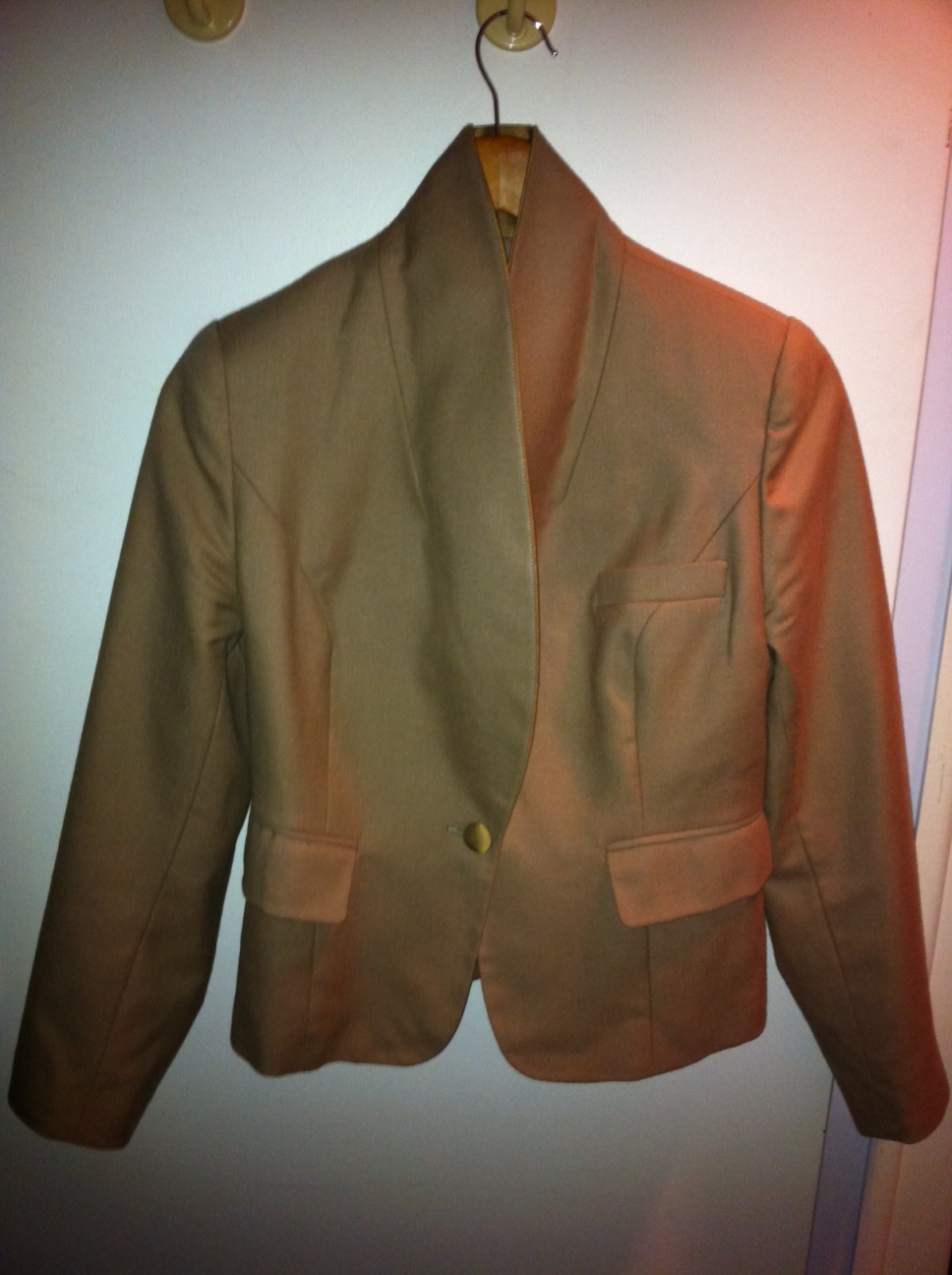
And last but not least: my favorite jacket. Ella was kind enough to significantly modify a much longer gray jacket, to make mine camel, pure wool, shrunken, and perfect. The collar is lined in shantung silk, and can be worn up or down:


Of course, it is lined in blended silk, and as you can see from seaming and pocket detail, it is really well built. So my wool and silk uniform has been updated with some key pieces, all of which are classic and yet so originally and wittily constructed that they are never boring and really stand apart from all others.

And here's the thing. These pieces all run between $50 and $100, which might seem high if you're used to Target and Old Navy. But these items are designed by someone who cares deeply about her work and takes pride in her craftsmanship -- the attention to detail, the seam quality, the fabric selection (that's some nice wool on that jacket). Not to mention, these are made for your measurements. And considering this, these pieces are not at all expensive. I can email the person who is making them, we can discuss color swatches, she can change length or a sleeve shape or the neckline if I ask her to. The interaction with the person who makes your clothes is important: it gets one thinking about the practices in mass manufactured clothing, and the human rights and environmental abuses become more difficult to ignore.

And I get the usual argument of "$50 bucks will buy me 10 shirts in Walmart/Target/ON", I really do. I'd be a liar if I said that I don't own any ethically suspect pieces myself. And it takes experiences like this for me to realize that I like knowing where my clothes come from. I like knowing that were not made using child labor or that the manufacturer didn't completely ignore local environmental laws. It's the issue of price and cost, really: every cheap piece of clothing has a cost associated with it. Ten bucks is the price, but what is the cost in lost jobs in the US, in the exploited workers overseas, in the environmental damage -- herbicide pollution from cheap cotton production, eutrophication of lakes, desertification, salinization of soils... This is the sort of thing we all are paying for -- be it in increased medical cost, or lost wages, or decreased bargaining power as international conglomerates continue to increase their political influence. They call it externalization: for every sweatshop they build, they are the ones getting the profit, and we are left with splitting the cost and thinking that we somehow got the better of the bargain, because hey, a dress for the price of a latte!

So I'm trying really hard to ditch the mass-produced and stick to thrifted and handmade, with a dash of off-the-rack items from companies and designers who at least claim to care about ethics. And I don't think true quality is possible without it.


Monday, October 04, 2010

About those pink ribbons

With October being breast cancer awareness months, we're flooded with messages of “awareness” = thinly disguised merchandising, and slogans like “Save the tatas” and other nonsense featuring words like boobs and tits, making the whole cancer thing oh-so-sassy. There's a lot of information out there about pinkwashing, and that's all good stuff. My issues with the way breast cancer is packaged go beyond that, however.

Sassy slogans that place the focus on eroticized notion of breasts is problematic, of course, because it sort of tends to overshadow the fact that there's a human being attached to the tits that need saving; secondly, as mastectomy IS often a life saving although drastic procedure, the focus on saving the breasts can be actively damaging to survival and health of women. Also, can we please talk about serious illnesses affecting women without trivializing, sexualizing and sassifying? Can we ever talk about women's cancers as human suffering? Is that too much to ask?

Now, to the notion of buying pink-ribbon stuff. Even if you follow the Think Before you Pink guidelines, I would still advocate separating your philanthropy from your consumerism. I'm deeply disturbed by the increasing tendency to merge them together – as in, buy yogurt and we'll donate a few cents off the profits to a charity. How about I just donate to the charity I want, and buy yogurt separately? I mentioned it before – I am troubled by the notion of voting with your wallet, as consumer decisions are becoming the main vehicle for political expression and activism, for a fairly significant portion of the population. We buy hybrid cars and long-lasting light bulb to express our commitment to the environment (rather than, you know, reducing waste or carpooling, god forbid), and now we have to buy t-shirts to support breast cancer? Which create more waste and pollution, which in turn increases cancers?

And much like with the environmentalism-based consumption, charity-linked spending creates a false sense of doing something good, while contributing little. A direct donation of $20 to a proper charity is philanthropy; buying yourself a $20 shirt (that comes with a promise of profits being donated to charity) is just buying yourself a shirt (and likely contributing to unfair labor practices). Any benefit for charity etc is likely to be negligible. And that's $20 you won't be donating, and another shirt you don't need.

And at the bottom of it all, why hand over your power to make charitable contributions to some manufacturer? Ultimately, you often don't know if they are doing what they say they are doing, and you almost never know how much their manufacturing practices are contributing to the carcinogenic environment we live in. So I think I'll stick to keeping things separate – and I think there's value in recognizing when one's engaging in consumerism, rather than pretending that it's something else.

Friday, September 17, 2010

Heteronormativity, and lack thereof

Tonight's Project Runway delighted me in several ways: Tim Gunn firmly insisting that Jackie Kennedy would NOT have camel toe was a definite highlight. I was also quite pleased to see Mondo win, and I enjoyed Ivy's design -- great to see that she's returning to the neutral, ethereal, and yet sharply cut. I liked the idea of Andy's pants (execution and styling were, admittedly, lacking). Most of all, I enjoyed Mondo's own outfit: short shorts and a white tank top, with suspenders, knee socks, and tons of eyeliner. When asked, Mondo said that he was inspired by Cotton Club, and did a little tap dance. This is also the same person who put a mustache on his model during the Treacy challenge.


This is where it struck me: I do love Mondo's design, but I also adore his refusal to behave in heteronormative ways -- much like I enjoy the same trait in Johnny Weir (who recently made an appearance on Rachel Zoe, OMG). And really, having people like them on national TV is a big deal -- it is important to see the diversity of gender presentation (and people happily adopting behaviors usually associated with the opposite gender) in order for this diversity to become normalized. Interestingly enough, it seems more normalized in fashion industry: in last week's Rachel Zoe Project episode, there was a fashion crisis involving Johnny Weir showing up to an event and finding out that someone else wore the exact same outfit. Zoe's staffer, Brad, flies to the rescue, and asks Johnny if he'd seen that episode of 90210 where the two girls wear the same dress to the prom. "Of course," Weir replied. "What kind of man would I be if I haven't seen that episode?" "Not a very good one," Brad says.

Both had a jocular manner during that exchange, but it still struck me -- the way these two redefined masculinity rather than refused it. Redefined it to include watching 90210 and caring about prom dresses and high heels as masculine behaviors. This reclaiming and widening of mainstream gender roles strikes me as quite a bit more constructive than simply rejecting the mainstream and retreating into an invisible niche. And what's more mainstream than TV?

Finally, On the Road with Austin and Santino is a hilarious and sweet series. This week's episode started with Austin getting out of the car in his straw hat and carrying a parasol, and shaking hands with a female truck driver. And you know, we need that -- rather than calling this woman 'masculine' or labeling Austin as 'effeminate', we need to see that their gender is not defined by what the mainstream deems gender-appropriate. We don't get to boot people out of their gender for the things they do.

I'm thrilled to see all these things on TV: of course, most of them are on Lifetime, which is commonly dismissed as a chick network. Oh gender normativity, how you vex me.

Sunday, August 29, 2010

Why Target boycotts ultimately miss the mark

So you all have heard that Target CEO donated money to conservative politicians who oppose gay marriage, and the Internet got as worked up as it did last year about Whole Foods - just like it does every time it becomes obvious that corporate interests are NOT the interests of their customers. Well, they're not, and boycotts only serve to reinforce one's role as a consumer rather than a political entity. Voting with your wallet is not voting or activism. (Schoolmarm aside: the term boycott refers to a mass action, because in order for a boycott to be successful, a significant chunk of the population needs to participate. Hence saying "I boycott something" is meaningless.)

Also: any place that sells you a new dress for $20 does not have good labor practices, no matter what they say. So if you indeed want to vote with your wallet, supporting child labor and unfair wages seems like a good reason to avoid fast fashion retailers, not just Target. Items produced while paying fair wages cost more, and unless we come to terms to t-shirts costing more than ten bucks, these practices will continue. American Apparel got slammed for higher prices - aside from the perviness of their ads and hiring practices, they went after the same demographics as F21, which has the same teen-disposable stuff that costs a lot less. I think they would've had a better chance emphasizing quality and domestic production and at least trying to appeal to people over age of fifteen/size 4, but they went with softcore and entirely too many mismanaged stores. Sic transit.

Ultimately, I see the debate about fast fashion going the same way as the debate about fossil fuels: we want to help as long as we don't have to sacrifice. But with biodiesel, we simply cannot make enough to make current demand, and both fossil fuels and modern clothing industry have too high a human cost. We have to reduce consumption - buy less clothes, carpool - rather than simply decide to boycott retailers who offend our industrialized world sensibilities. It's the volume of consumption that's the problem.

This is why I've been advocating vintage and indie designers -- sure, the indie designer stuff costs more, and the oft-heard argument is 'I can't afford to pay hundred bucks for a dress'. And this is the idea behind readjusting one's clothing budget -- even when it's small, there's always a choice of buying one (more) expensive thing vs several cheap ones. And that's a good reason to avoid Target and other cheap clothing retailers -- even if they give money to all the right causes, the labor practices they condone aboard (and domestically, in many cases) is reason enough to ignore them. Additionally, I believe that activism -- demanding that labor exportation is restricted and the corporate practices are overseen and regulated -- will yield better results than wallet-voting. Perhaps one day we'll be able to walk into a store and expect to buy things without worrying how horribly mistreated the workers were, or how young was that kid working the sewing machine.

Monday, August 16, 2010

Sartorial Other

(This post is an expansion of my comment at Threadbared -- and I heartily recommend the post that spurred it.)

Sartorial othering -- recognition of people of different religion, ethnicity, nationality, political leanings etc etc by their clothing -- is an old tradition. In more extreme cases, certain groups may be forced to wear certain easily recognizable items of clothing that mark them as others. More commonly, as Threadbared writers so acutely put it, clothing becomes an extension of the person, it becomes epidermalized. They talk about how "ethnic" clothing is often perceived as one with the person who's wearing it, especially if talking about an ethnically distinct other.

Now, in cases when the other happens to look just like the dominant group, their clothing frequently becomes a substitute marker of ethnicity. Take Borat, for example -- oh, how people laughed at his too-short shorts and too-long socks. Neither of those things are of course specifically noteworthy, except when they indicate a person who does not belong -- and too clueless to know it. There's also safety in the belief that the other can be recognized.

It's interesting to see how this otherness is reflected on Eastern Europe, specifically -- since its denizens appear white and yet are not culturally and economically a part of the Western European/Anglophone culture, but rather that curious and unknowable Other. This perception is quite clear, for example, when The Sartorialist talks about Moscow's "Blinged-out Versace-ism" (clearly, he is not aware that most people there can't afford Versace, or, you know, H&M for that matter), or that blogger I referred to in Threadbared comment (the one who said that she recognized that a woman was Russian because of her overbranded clothes). There's certainly a poorly hidden contempt behind those perceptions; the same contempt one can witness in many comment threads of New Your Times blog, where people lament the proliferation of logo-heavy Coach bags. It's not that they mind overpriced bags; it's the people who advertise the ownership that bother them. It's the contempt of old money for the nouveau riche, of upper class for the upward aspirations of lower-middle.

So it's a curious sartorial bind we find ourselves in: dress in short shorts and long socks and be ridiculed for your backward ways, or try to adopt the values of the West and be ridiculed for too many/wrong logos. (There's of course also a possibility of being exoticized, as demonstrated in The Sartorialist.) For Eastern Europeans living abroad, there's a premium on sartorial blending -- if you dress right and keep your mouth shut, you may pass. But it's difficult to forget that one is just one pair of fake Gucci sunglasses or two inches of sock length from being outed.

OTOH, last winter when I was in Moscow it struck me how many people wear fur. Yet another reason many foreigners in Moscow look down at the native ways -- as if they themselves just woke up one day to realize that wearing fur was wrong. No, the realization was due to decades of activism and message bombardment, from PETA, most obviously, but also from other animal rights organizations. Bombardment that is still virtually absent in Russia, so tut-tutting at people for not internalizing the message they haven't been exposed to strikes me as yet one more way of othering and alienating. (Activism for animal rights, on the other hand, is a perfectly reasonable thing to do. It's the sneering superiority that gets me.) So it really is amazing how quickly cultural norms become distilled down to perceived dress codes, and the perceived dress codes to hierarchical judgments.

I'll leave you with this Russian Vogue cover, May 2010.

The bold text says, "Our pride". And there's certainly that.

Sunday, October 25, 2009

Schmatta

Just watched the new HBO documentary on garment district, "Schmatta: From Rags to Riches to Rags". Very pleased with it, since it combines two of the things I'm keenly interested in -- fashion and history of organized labor. The film does an excellent job covering the beginnings of the garment district and its immigrant roots, the 1911 fire at the Triangle Shirtwaist Company that took lives of over 100 young women -- workers who were locked inside the factory -- and how that fire became a catalyst for organizing workers (especially women) of the Garment District. There's plenty of documentary footage -- from terrifying to uplifting, as the film deals with labor unions gaining strength and their role in the rise of the middle class of the New York City. Oh, the golden days of unions wielding real political clout! Children of early labor activists are so wistful when they talk about that time.

Then it gets depressing again, as we are shown gradual weakening of the unions and downright union busting by the Reagan administration, the export of jobs overseas, and the overall deregulation of market that resulted in even more losses in domestic jobs and rise in exploitative sweatshops overseas. It is shocking to see that in 1965 95% of clothing sold in the US was made in the US, and soon after 1993 ratification of NAFTA agreement by Clinton that number dropped to 50%. Now it's only 5%.

The documentary then touches on the issues with sweatshops, concluding with the fire in a textile factory near Dhaka, Bangladesh, that killed dozens of workers, most of whom were girls between 12 and 14 years of age. They were locked in the factory, in an eerie echo of the 1911 tragedy.

Another thing I found interesting is their commentary on disposable, cheap clothes produced by Forever 21, H&M etc. -- the idea that if people demand cheap clothing, there's just really no way for the American garment industry to recover, simply because it is impossible to pay minimum wage while making $10 dresses. Stronger unions and stricter market regulations, with limit on exporting jobs to the overseas, seems to be the key to recovery of the local industry -- but of course that would mean that Target and Walmart prices will become the thing of the past.

This is something I've been thinking about quite a bit -- I try to get a good chunk of my clothes from indie designers (which reminds me: I'm due for another Etsy post), since they are a) local and/or b)likely don't have a sweatshop. Yet, I'm not entirely ready to jettison all bargain retailers from my wardrobe (I don't have a lot, but a few) -- primarily because I don't feel that shifting all ethical responsibility to the individuals instead of governments is fair, and the admonishments to 'vote with your wallet' results in an unpleasant situation where every political decision is expressed via buying stuff, which I think largely misses the point. Still, I hope that the US government will take steps to bring manufacturing industries home, and then I won't mind paying a few bucks more for my shoes.

In other words, this documentary is highly recommended. It's playing on HBO (and On Demand).