Wednesday, September 05, 2012

Izumi Hongo, 2012 Collections

Izumi Hongo's brand, Van Hongo, continues to amaze. I am terribly late in talking about Spring/Summer 2012 collection (and let's be honest here, I'm so much more in love with Fall and Winter clothing), but better late than never. Previous reviews can be found here and here.


First, the summer and spring clothing of Intimate Luncheon look both lightweight and substantial due to clever use of texture -- something Hongo definitely excels at. From photographs alone, one can recognize heavy silks, textured linens, and chiffons juxtaposed with denser, draped fabrics.


The palette is heavy in creams, greys, and acid yellows and greens -- something Hongo gravitates to. This collection seems especially pared down in color and the silhouettes are also tending to more classically feminine -- shifts, crossover tops, floaty skirts predominate, with an occasional tapered trouser thrown in. It of course fits the name: with all Hongo's collections, a name alone strikes you as fanciful, but then you look at clothes and go, "of course". "Luncheon" evokes the image of traditional femininity, ladylike and classic; the intimate part strips away the formality -- pearls and hats and gloves, leaving simplicity clad in contrasting textures, familiar and yet delightfully new.


A/W collection, Recording Room, is as similar to her previous Salonniere as it is different -- the palette of purples and mustards is familiar, as well as pleated trousers and spiderwebby knits. However, she also shows more simplicity in shapes and textures: no more velvet or kite-back shirts, but again the simple silhouettes. The most noteworthy addition perhaps are the simple, long sleeved shifts, straight and basic, devoid of any elaborations but the exquisite, cashmere-like drape.


There are some flourishes on a few of the pieces -- a scattering of sparkle against the inky-violet dress or a blouse, an occasional origami pleat on a skirt -- but those too read as restrained. There are exquisitely cut coats that evoke Jil Sander with its luxurious minimalism, and woolen, snuggly pleated skirts. And of course, there is a piano pictured in some of the lookbook shots -- it is, after all, a recording room.


The connection in this one is perhaps more oblique than in Intimate Luncheon -- but the sense of melancholy, of the autumn sun struggling to come through the wooden slats of the walls and bursting in through the cracked door is fitting perfectly with the artist's wardrobe; or rather, a fantasy about the artist, a stylized tableau meant to evoke an ideal, an ur-musician of many daydreams. Her clothes are luxurious and interesting all at once. The interest, as always, is generated primarily by textures, and I am glad to see so many simplified cuts that still fully embody Hongo's esthetic. And yet there are still enough architecture in these minimal pieces to make them true standouts. Just look at the long knits, not quite cloaks, not quite shawls, or at the carefully crumpled button up shirt.

So yeah, still waiting for the day these will show up in my local boutiques. For now I will have to write gushy reviews.

Sunday, September 02, 2012

Today in Moral Panic


(Photo credit: www.zara.com, Zara Woman campaign featuring Freja Beha Erichsen)

So a number of news outlets ran a story about Zara -- a fast fashion chain, who is apparently not doing as well in the US as the rest of the world due to the fact that their sizes run small. That part itself isn't particularly controversial -- I am not a big Zara shopper, as I tend to avoid fast fashion in general, but occasionally I am tempted to try on an especially trendy jacket (haven't bought anything yet), and I know their sizes are actually the same as most designer versions (which tend to be almost aggressively anti-vanity sized). But compared to Gap, Banana Republic, JCrew these sizes do run small. Or, if you prefer, Gap etc have fallen victim to "vanity sizing".

I find the term "vanity sizing" very curious -- it seems to place the responsibility on the wearer rather than a manufacturer. As if it was the wearers who demanded that the manufacturers redefine their sizes to assuage their egos. This is of course not the case -- women for one didn't decide that they need to fit into the smallest size possible in a cultural vacuum. The media is saturated with references to acceptable sizes for women -- size eight, four, zero have all been touted as THE size every woman should fit into or at least get as close as possible to be socially acceptable. Without those 8s, 4s and 0s referring to a real thing (like, say, a specific measurement in inches) what is to stop the manufacturer from shifting those sizes to sell more units to women, basically luring them with promises of social acceptability IF THEY BUY THIS DRESS? Nothing, of course, and it is not the wearers and the buyers who are to blame -- it is the unrelenting pressure from the society and the basic tenet of capitalist economy: dissatisfaction will keep us buying. But yes, we still blame the victims. NB: and of course since there isn't a TRUE size 0, 2, 4 etc, since sizes are arbitrary anyway, so the whole "vanity" thing is a bit of red herring. But I'll roll with it anyway.

(Of course if it was indeed the issue with people getting bigger, the sane response to it is not to redefine the existing sizes but rather add more clothes at the larger end, and extend the sizing as necessary. But now many stores are not carrying anything over the size 16; plus-sized departments are often depressing, ghastly places populated by juvenile ruffles, sassy t-shirts, and potato sacks. Although this is changing, attractive larger clothes are still hard to find, and plus-sizes are still segregated. And we are forced to conclude that vanity sizing is not the result of the manufacturers trying to accommodate a larger customer but rather to sell more crap by peddling illusion of social acceptance).

The victim blaming, hand-wringing and pearl-clutching get fascinating in comments to those Zara articles. It is perhaps best exemplified by the following comment: "Vanity sizing is partially responsible for the obesity problem in America. If a women buys a dress and the tag says she is a size 6 when she is really a size10, then she feels her body and weight are just fine because she is fitting into a size 6."

Yes, people. Vanity sizing is killing us all because apparently there are fat people among us who don't realize how truly fat they are (hint: there are not a single fat woman in the Western world who doesn't know she is fat. We remind them daily.)

Then there is an issue of morality, again. You see, Zara is a business, and their sizing is not a moral choice but a business one: do they need to extend their sizes (which, by the way, is different than vanity sizing -- they can keep the existing sizing scheme but simply carry additional larger sizes) to accommodate customers who would be happy to give them money if they could find clothes that fit? Many commenters don't think so. They approach it as a moral issue (you don't deserve these clothes!):

"Americans need to lose weight...period! I am 5'7" and weigh 115. I am a zero in vanity sizes at stores like Banana Republic, or Old Navy. At Zara and H&M, I am a 4! If these stores change their sizing, they will need to make xxxs to accommodate the leaner individuals, such as myself! I say, keep the sizing chart as it is Zara! If fat Americans don't like it, tell them to eat a salad:)"

Zara should apparently just fail financially to make a point. Not to mention, that I wonder if people who are sized out of Zara are truly the ones who are seriously overweight. Most people who shop at plus-size stores are unlikely to set foot in Zara and such retailers (and if they did, they would likely be hustled out of the doors by salespeople.) But that of course is besides the point; I do find it interesting however that to many people accommodating larger sizes seems to mean discontinuing the smaller ones, which of course it doesn't have to, not to mention catering to the rampant self-indulgence.

So on balance, it seems to me that complaints about vanity sizing are just a form of concern-trolling (but how will fat people know they're fat? This ignorance might kill them!!!) Because really, everyone deserves flattering and well-made clothes that make them happy. The manufacturers are of course free to define their customer base; they are free to shoot themselves in a foot if they are so inclined. But let's not pretend that their decisions are at any point driven by morality -- even when they should be, like when they use our anxiety to sell us crap.

Monday, August 20, 2012

Kate Upton Vs The New Ascetics


(Kate Upton for Vogue, 2012)

Remember the internet dust-up a few weeks ago, when SkinnyGossip published an article titled "Kate Upton is Well-Marbled"? There was much to do about that particular piece -- people arguing that Upton is thin vs people defending their life choices of living in a restricted-calorie state and "preference" for a thin look. While I think it might be important to mention that this argument rather misses the point and that perhaps we shouldn't treat women's bodies as public property, to comment on and to criticize, this is not what I'm on about today.

I want to talk about the role eating disorders are currently fulfilling in our spiritual landscape, and how that role may explain the hatred directed at Kate Upton. SkinnyGossip is of course a thinspo site, their disclaimers warning away individuals with eating disorders notwithstanding. Women on that site have their high weight, current weight, and goal weight in their signatures; goal weight for many of them who are 5'8" or taller is under 100 pounds. The quotes in their signatures are chilling: "I have not eaten yesterday and I will not eat tomorrow" made me do a double take. And they all focus their vitriol on Kate Upton for being fat, while her defenders argue that she is not. This is of course not about fatness but rather about someone who has publicly eaten food and is not sorry about it.

What went unremarked upon during this whole thins is something that is rarely mentioned in such debates: regardless of what fashion magazines may or may not promote, regardless of the societal pressure on women to conform to the (currently very thin) ideal, they do not make eating disorders happen. Stopping eating is difficult, refusing food on a regular basis is so much against every human instinct that most of us are not capable of it -- it's kind of like holding your breath until you suffocate. So anorexia is not a behavioral choice so much as it is a disease. Moreover, anorexia is an old disease, dating to long before fashion magazines. Self-denial of food, has been traditionally linked to religious mysticism, and by extension -- virtue. It is a form of extreme-self control that usually serves a purpose in an individual's psychological landscape far beyond mere vanity. It fulfills a deep need -- usually for control, but whatever it is, it is driven by much more than simple will.

So my sense is that the thinspo community is lashing out at Kate Upton not because of her violation of our notion of beauty, but rather because of the perceived violence she does to morality and virtue. Consider for example this comment from a SkinnyGossip forum user: "She´s "relatable" for girls as well, since her body type isn´t hard to achieve, nothing to look up to. No need for discipline, dedication, workout, restricting." It is a remarkably revealing sentiment -- illuminating the idea that success in modeling should be deserved via sacrifice. You see, a modeling career in this world is elevated to a mystical status akin to a monk's achievement of spiritual enlightenment through a fast in a desert. If another monk achieves the same state via hanging out on a couch eating bags of Twizzlers, I bet all the other ascetics will side-eye him like whoa.

Upton is disliked because she supposedly bypassed the self-flagellation route and attained success (=spiritual enlightenment) and is thus a cheat, rightfully despised by those dutifully sacrificing and restricting. The proof of her moral failures is well-documented in her campaign for Carl's Jr:


See? She is eating fatty foods, and yet she is walking the enviable runways and booking photoshoots in Vogue -- right after everyone under the sun said that she is not high fashion and just commercial, that the only people who like her have no taste. She is a failed model -- because models are the new mystics, whose power can only be achieved through self denial and rigorous flagellation... I mean, exercise. And yet, somehow, mysteriously and annoyingly, she is successful. Thus, the judgment passed on her is not the one of vanity but that of moral failure -- and this is why it is so harsh. Her crime is not being fat but rather being successful despite the lack of corresponding self-denial.

So on balance, I really do feel bad for Upton's critics. Thinspo sites exist for those with eating disorders to come together and feed each other's delusions, to reassure each other that they have chosen the right path - the only path to spiritual salvation, even though (especially since) it can lead to physical destruction. After all, bodily sacrifice is acceptable on a spiritual quest. What however is not acceptable is the living proof that the purpose of the quest is ultimately hollow. This is when we band together and deride the person who so rudely pointed that out: after all, they do not deserve their good fortune, those cheats and gluttons and sloths. It is only for the virtuous -- the ones who wear their commitment on their 30 inch hips.

Or, in the immortal words of Emily Blunt from "The Devil Wears Prada", "You don't deserve [these clothes], you eat carbs!"

Thursday, July 19, 2012

More on Ukrainian design

I wrote already about Ukrainian designers and how impressed I am with such a vibrant and diverse community. I like the variety of sensibilities and the fact that so many of them match mine -- classic with a top note of avant garde, clean-lined, with cohesive palettes -- from Vozianov's pale neutrals to Kanevskiy's disturbing reds and blacks to KamenskayaKononova's feminine blushes and pastels. So yes, I am a fan, a convert, and an enthusiast. And now apparently an evangelist.

In my first outfit post, you can see my favorite jacket by Fedor Vozianov, the fashion designer and a linguist. How much do I love that jacket? A lot, actually! I was ecstatic when I got it in the mail. And still am that it is in my closet. A friend recently expressed his surprise that I don't wear it every waking hour. What can I say? I am shocked too!

Now, shopping overseas even in the days of the internet is daunting: shipping charges, inability to try things on, returns taking forever... but the rewards can be great, and thankfully there are now many places that make it a painless and pleasant experience. In this case, I was very happy to find the boutique in Kiev, Suitster, that not only carries all of my faves, but also ships overseas, and has the founder who is friendly, communicative, and really goes out of her way to make sure everything is right -- from obtaining measurements of the pieces in the store to actually communicating with the designers to make pieces to order. The sight is in Russian and English, with English listing pricing in dollars in addition to hryvnias.

Quick aside: I wish more stores chose to highlight local talent rather than well-known brands.It's a risk, but I cannot tell you what joy it is to browse the online store and to know that all of the clothes are locally made. They even have a section highlighting the newly emerging talent, in addition to established professionals (and you can easily browse by designer as well as the category). Not an imported dud in sight!

Anna Pashchenko, the very fashionable and  accomplished businesswoman, is a joy to work with. Each time I wanted something, I emailed her, received a prompt response, and was always delighted at how friendly and helpful she was. I was so encouraged with how well the jacket transaction went, that for my birthday I decided to order a couple of pieces. First, this shirt by it's me:


Gorgeous, right? Semi-sheer cotton and vsicose batiste, it drapes as well as silk, and the back of the collar is open, creating a really cool effect:


The back yoke, collar, cuffs, and pockets have an extra fabric layer, so they are more substantial and sturdy than the rest of this gauzy shirt.

I also really loved these pants by Ksenia Shnaider:


They were not available in my size, but magical Anna took my measurements and ordered them for me. The pants are substantial silk, and the polka dots are raised, swiss-dot style. Notice also the neat pocket placement -- you get the pockets without them throwing off the line of the hip. Bonus!

So this is how these pieces look on me:


I do intend to wear them separately, but they do sort of work together! So may thanks, Anna and Suitster!

And  next time there is gift money, I think I might get this vest by Kanevskiy:


And I really cannot recommend the store highly enough. And look, they have teddy bears!


Thursday, May 31, 2012

CIRCUS: Fantasy Under the Big Top

So finally I turned in the manuscript for my reprint anthology, CIRCUS: FANTASY UNDER THE BIG TOP. Many thanks to everyone who suggested reprints -- your help certainly pointed me to a number of stories I wouldn't have seen otherwise, and the book is better for it. Now, for the good stuff, cover and table of contents:


CIRCUS: FANTASY UNDER THE BIG TOP Table of Contents
Introduction
“Something About a Death, Something About a Fire” Peter Straub
“Smoke & Mirrors” Amanda Downum
“Calliope: A Steam Romance” Andrew J McKiernan   
 “Welcome to the Greatest Show in the Universe” Deborah Walker
“Vanishing Act” E. Catherine Tobler
“Quin's Shanghai Circus” Jeff VanderMeer
“Scream Angel” Douglas Smith
"The Vostrasovitch Clockwork Animal and Traveling Forest Show at the End of the World" Jessica Reisman
“Study, for Solo Piano” Genevieve Valentine
“Making My Entrance Again with My Usual Flair” Ken Scholes
“The Quest” Barry B. Longyear
“26 Monkeys, Also the Abyss” Kij Johnson
“Courting the Queen of Sheba” Amanda C. Davis
“Circus Circus” Eric Witchey
 “Phantasy Moste Grotesk” Felicity Dowker
“Learning to Leave” Christopher Barzak
“Ginny Sweethips' Flying Circus” Neal Barrett Jr   
 “The Aarne-Thompson Classification Revue” Holly Black
 “Manipulating Paper Birds” Cate Gardner
“Winter Quarters” Howard Waldrop   

Tuesday, May 22, 2012

Outfit post 2

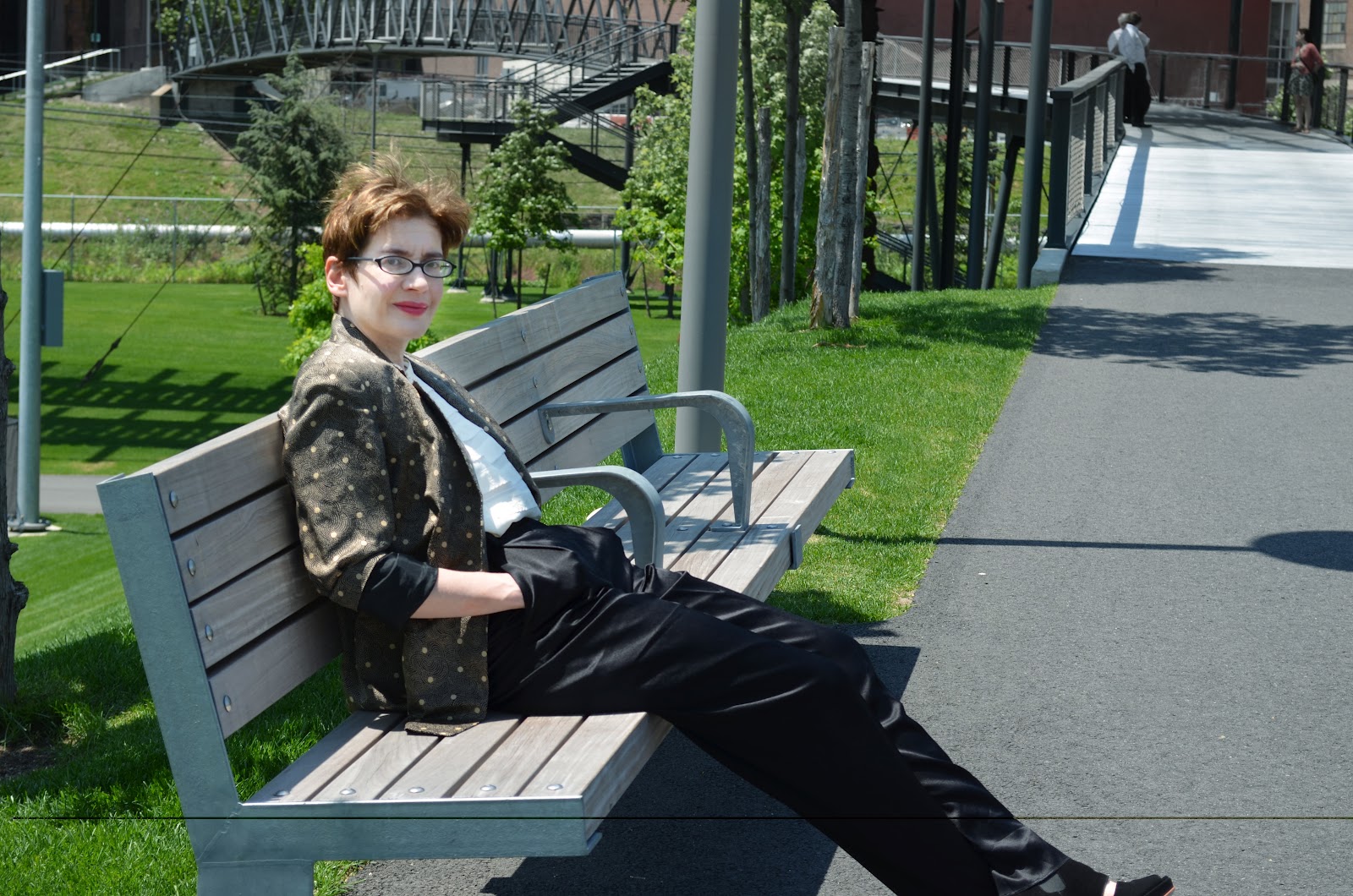
This is the second outfit I wore at my photoshoot. Here, I went for a completely different proportion with highwaisted, pleated silk pants (anathema in all flattering dressing gurus' books). I played with proportion some more by adding my highest heels, and a patterned jacket.

 Here's a better view of the jacket (vintage Anne Klein -- old enough for the ILGWU label, natch):

And without it. The blouse is vintage, the only inherited piece I have -- from a German great-great aunt.

Also, check out that Marni cuff! You can probably guess how many Wonder Woman comments I get when wearing this one.

Most of these pictures were taken around the UPenn Museum of Archeology and Anthropology in Philadelphia. Statues and fountains!


 (And a better view of the shoes. These are my most comfortable heels even though they are the highest -- Rachel  Comey shoes are a fave.)

Again, many thanks to JR Blackwell. I learned several things during this photoshoot: black and white, my natural inclination, is the way to go, apparently -- I really like the way they play against the background. Also, I like the way these photos look, so to me it means that my outfit ideas translate pretty well into the actual presentation. I like clothes like these -- interesting yet slightly formal, classic but with a bit of an off sensibility. Silk photographs really well, even the shiny McQueen pants with their fluid drape which I worried would look cheap in pictures.

So with all this -- maybe I'll be posting more outfit photos now. If only I can get a pro photographer to follow me around!


Monday, May 21, 2012

Outift Post 1

This week, I worked with the very wonderful JR Blackwell on my very first photoshoot. It was a very fun experience, and in addition I now possess a ton of great quality photos of myself in all sorts of interesting Philadelphia backgrounds; so decided to do a couple of outfit posts, since I natter about clothes so much but almost never post any actual pictures.

So here we go, outfit one -- black silk jersey dress (Catherine Malandrino), silk Vozianov jacket, and Miu Miu slingbacks:

 I love this jacket's sculptural shape. It looks completely different from the side than from the front, so here are a few more views of it. The fold of the lapel works as a pocket for hand-placement purposes:


 Notice the sharp angle of the lapel that gradually becomes a tail:


The dress itself is fairly simple, but it drapes beautifully. This picture does a nice job highlighting the overall silhouette:


Many thanks to JR for taking these! I'm very pleased with the way the pictures came out, and the locations she picked. Later this week -- my other outfit.

Saturday, April 14, 2012

Bloody Fabulous -- The Definitive Post

BLOODY FABULOUS, the anthology of urban fantasy about fashion, has an Amazon Listing!

And a cover:


Table of Contents:

“Coat of Stars” Holly Black
“Savage Design” Richard Bowes
“Bespoke” Genevieve Valentine
“Dress Code” Sandra McDonald
“The Anadem” Sharon Mock
“The First Witch of Damansara” Zen Cho
“The Faery Handbag” Kelly Link
“The Truth or Something Beautiful” Shirin Dubbin
“Waifs” Die Booth
“Where Shadows Meet Light” Rachel Swirsky
“Capturing Images” Maria V Snyder
“How Galligaskins Sloughed the Scourge” Anna Tambour
“Avant-n00b” Nick Mamatas
“Incomplete Proofs” John Chu

And here's my Introduction to this wonderful collection:

My last two anthologies have been about shapeshifters and werewolves, so when I talked to people about editing an anthology dealing with fashion, the reaction more often than not has been puzzlement. But is it really so much of a stretch? We talk about shapeshifter stories being the means for manifesting our secret selves to the world. But is this so different from fashion?

We pay attention to what we wear because style and fashion are among the means of nonverbal communication. And we tell the world what we want to be today. It’s not a secret that we use the sartorial signifiers in fiction – we know the noir detectives by their fedoras and trench coats, we recognize paranormal investigators by their skin-tight leather. Princesses wear yards of chiffon and ballerinas have tulle; pirates enjoy ruffled shirts, and businessmen have their Brioni suits. So why not write a few stories in which the outfits themselves, the aspirational skins of our inner selves become the characters? Why not let those who create those garments for us tell their stories? Because who is better to explain how important our clothes are than those who spend their days immersed in creating them and imbuing them with meaning!

I think it was Ru Paul who said (and I am paraphrasing) that we come into the world naked, and everything else is drag. I want to agree with that, but I also want to think that this drag is not coincidental but magical in a way. We cannot turn into predators, even if there is a full moon outside – but we can wear jackets with metal spikes on the shoulders to feel a little bit more dangerous. Our clothes give us some shape-shifting abilities – from ethereal to tough to glamorous in a single day! They give us the means to tell the world who we are today (or who we would like to be) without uttering a word. And they let us play and pretend, manipulate our gender presentation as well as other aspects of sartorial personas: clothes are the ultimate disguise, alluring enough to bring a shapeshifter out in all of us.

So I hope that these stories will inspire you to look at your clothes with new eyes. There are so many characters here – from sales clerks to designers to fashion bloggers, from fantastical to historical to mundane costumes, from fashion magazines to fashion accessories; and every story offers a new way to look at what our clothes are, where they come from, who decides what is fashionable anyway… but most of all, how our clothes cast such a spell over us – and how we can use them as faery glamor, to cast a spell of our own, and to pretend to be our secret selves. Be your clothes shapeshifting or disguise, these stories will be your co-conspirators as you offer the world a sly glimpse of your sartorial heart.

Monday, March 26, 2012

Quick one

Got back from Denver. Had a great time meeting writerly friends and exploring the city a bit. Hopelessly behind now, so important things:

WILFUL IMPROPRIETY has a cover! This is the US version -- the UK one will have "Wilful" spelled like so. The art, however, is amazing, and I love it.


Thursday, March 15, 2012

Bloody Fabulous ToC and Writerly Updates

First of all, BLOODY FABULOUS, the anthology of urban fantasy about fashion, now has a Table of Contents!

“Coat of Stars”  Holly Black
“Savage Design”  Richard Bowes
“Bespoke” Genevieve Valentine
“Dress Code” Sandra McDonald
“The Anadem” Sharon Mock
“The First Witch of Damansara” Zen Cho
“The Faery Handbag” Kelly Link
“The Truth or Something Beautiful” Shirin Dubbin
“Waifs”  Die Booth
“Where Shadows Meet Light” Rachel Swirsky
“Capturing Images” Maria V Snyder
“How Galligaskins Sloughed the Scourge” Anna Tambour
“Avant-n00b” Nick Mamatas
“Incomplete Proofs” John Chu

I so love all of the stories collected here, and cannot wait for this one to see the light of day. And hey, fashion bloggers! Email me for a free review pdf, ok?

Second of all, the very amazing Asengard Edizioni, the Italian publisher of The Alchemy of Stone, revealed its cover:


And finally, I am being interviewed at Airship Ambassador, where I finally explain myself about Heart of Iron. Stay tuned for part two!

Wednesday, February 22, 2012

On Beauty


I know I talked about this before -- this impossibility for a woman to opt out of the sex object thing; and many people agree and yet the beauty ideals are still... difficult to discuss. So let me start with a few thoughts and see how they congeal. Also, I want to make it clear up front: I understand why and how women absorb and internalize the demand for beauty. In this case, I feel that the onus is on the society to stop demanding those things rather than on women to simply get over the demand.

"Every woman deserves to feel beautiful". I saw that sentiment expressed on FB and in general media, and I kind of hate it. Because what they mean to say, I think, is that "every woman deserves to feel worthy". It's just that we only allow women to have one kind of worth, and this is the limiting part, not the narrow beauty ideal. (NB: One deeply problematic area of narrow beauty ideal is its whiteness that has spread way too much due to the Western cultural imperialism.)

And yes, the beauty ideal is narrow. It has always been! I'm not exactly comfortable with people rebelling against the limiting view of beauty as very thin and tall by proposing no less limiting version of curvy Christina Hendricks and Marylin Monroe, often sprinkled with a dose of body-hate and misogyny in the form of "Bones are for dogs, meat is for men". Leaving aside that Christina Hendricks' body shape is no more achievable or inclusive than that of Kate Moss (or any less white, for that matter), I object to the idea that women are object for consumption. "Meat", really? And that's the cry of empowerment?

Female competition sadly often goes back to the patriarchal divide and conquer mentality. If they convince women that their only worth is as objects of beauty, to be consumed by men, and that women have no worth outside of this realm, than arguing who's the fairest of them all is understandable although no less problematic. The struggle should be not to make the beauty ideal different, but to tell the world that we are not obligated to feel or be beautiful. Because when they tell you "every woman deserves to feel beautiful", they mean "You MUST try to be beautiful to prove your worth to us."

So then there is a whole ridiculous thing about models. It is often interestingly lumped with other things, like demonizing of eating disorders and transphobia. Take this article for example:

"To me, selling women's clothes using a teenage boy's body is the ultimate cynicism. It's as if the fashion industry is saying, 'Here is the perfect woman for our clothes: a boy!' " says style guru and "Project Runway" mentor Tim Gunn in his forthcoming book "Tim Gunn's Fashion Bible: The Fascinating History of Everything in Your Closet." (He is talking about Andrej Pejic, pictured above.)

(Because clearly non-binary gender constructs have no place in the world today. Androgyny boo.) Also, showing clothes on a certain body type really says little about who should wear their clothes. If you want to encourage more body diversity in fashion, it is easily accomplished. Here: HEY DESIGNERS! CUT YOUR CLOTHES IN SIZES BIGGER THAN 8! Here, done. Lack of body diversity in fashion is not to be blamed on models but lack of sizing ranges.

I don't mind that models look the way the do, as long as it is not expected of ME to look that way. I hear women complaining about magazines with models and actresses and how hard it is to not get jealous and to not hate your own body. And sure, it is hard if the expectations of beauty has been internalized, and I am not blaming them. And yet I wonder, if you see an article about a doctor, should you hate yourself for being unable to do surgery? Of course not. Different jobs, different requirements. Actresses and models are paid for looking a certain way. Just don't expect EVERYONE ELSE to want to look like that for FREE. (Because to do most other jobs? I can be the most hideous troll and a successful scientist! Or a teacher! Or a construction worker!)

And beauty is an imposition. It requires a lot of maintenance, lifestyle changes, expenses. Demanding that an average woman engages in all this extra activity and expense just to prove her social worth is unconscionable. And the irony of course is that people like Tim Gunn, who lament the anti-woman stance of fashion industry are also the same ones who engage in the whole advice regarding body flattery and creating socially acceptable shapes rather than telling women, "You know what? You are a human being with inherent worth not tied to your appearance or style or weight or interest in fashion. You can love clothes and makeup, but you are not required to; you can make yourself beautiful, but you are not obligated to, and we won't think less of you if you are ugly, fat, indifferent to fashion and not seeking male approval every waking minute."

So on balance, I feel that people who tell fat women to "create a waist" with a belt (looking at you, Tim Gunn!) or to never wear short skirts if over 40, can shove it. So can people who complain that models are too thin (their body type is certainly not common, but neither are Marylin Monroe's) and say clever things about men liking meat (because this is what you are, ladies: a product for male consumption). And maybe, just maybe, everyone should just stop telling women what to do, or be, or aspire to. Because the tricky thing about humans is that we all have our desires and interests and inherent worth, and in 2012 I think we can all agree that women are a part of humanity.

Tuesday, February 21, 2012

Russian Harry Potter Fandom is Awesome!

So  blades_of_grass  linked to this amazing Table of Contents, posted here, and authored by (c) sadcrixivanfrau_derrida_palka. This is meant to be a ToC for ENCYCLOPEDIA OF FEMINISM ACCORDING TO HARRY POTTER. Of course, as it’s third wave, there are quite a few intersectional articles. What I want to know is why is this not real!

Anyway,  blades_of_grass kindly asked for permission to translate this gem on my behalf, because I feel everyone should see this. With many thanks to the talented authors, here’s my translation:

ENCYCLOPEDIA OF FEMINISM ACCORDING TO HARRY POTTER.

The Practice of Female Separatism in Daily Life of Luna Lovegood

Hermione Granger on Liberal Feminism

Female Empowerment in Academia Through the Eyes of Minerva McGonagall

Women in Politics: The Dilemma of Dolores Umbridge

Women in the Military and Psychological Violence: The Case of Bellatrix Lestrange

Consequences of Limiting Abortion Rights: The Tragedy of Lily Potter

The Death Toll of Unpaid Labor: The Duel of Molly Weasley and Bellatrix Lestrange

Replication of Violent Family Practices: Family Strategies of Nymphadora Tonks

The Duality of Economic Strategies for Women: Narcissa Malfoy

The Internalized Misogyny Among Successful Women: Rita Skeeter

Woman as a Scapegoat in Political Processes: Marietta Edgecombe

Forced Marriage as a Conduit of Classism: Pansy Parkinson

Fatphobia: Millicent Bulstrode

Ridicule of Victims of Violence as a Form of Demonization: Moaning Myrtle

The Founders of Hogwarts, or Men are Always in Charge: False Equality

Hufflepuff and the "Virtue of the Working Class": The Silent Majority

Cho Chang: The Relations with Racial and Ethnic Minorities as a Casual Entertainment

The Marriage of Ginny Weasley: "Woman Exchange"

Good Homosexual is a Well-Educated White Men with No Sexual Liaisons: Albus Dumbledore

Polyamory and Childfree Lifestyle -- Self-Positioning of Bellatrix Lestrange

Ariana Dumbledore: Murder of a Disabled Person as a Social Necessity

Argus Filch: Even Harry and Ron Can Laugh at the Handicapped

Goblins: The Apotheosis of the British Antisemitic Tradition

Flitwick and Hagrid: Ethnic Minorities Will Always Clean Up After You, or Uncle Tom in Hogwarts

If the Protagonist is Fed, Slavery is Awesome: House Elves

Only Stupid Girls Fight Slavery

Hermione Granger: A Good Woman Defends Others' Rights and Provides Others' Lessons

Alcoholism and the Esoteric: Coping Mechanisms under Conditions of Discrimination

House Elves: Just Like Women, Only Ugly and Invisible

Pomona Sprout: Good Girls are Liked but not Noticed

Professor Vector, or Anonymity of Women in Mathematics

Poppy Pomfrey: a Subservient Suffragette, or the Outcome of Courses of Higher Women's Studies in St Petersburg

Bellatrix Lestrange and Luna Lovegood: Psychiatric Disabilities and Ableism in Hogwarts

Luna Lovegood, Tom Riddle, Harry Potter: Good Children Don't Get PTSD

Luna Lovegood: Forced Acceptance into the Family Strategies of Psychological Repression

Conventional Man is Allowed Anger but not Grief. Harry Potter: The Masculinity Trap

Remus Lupin and the "Good Cripple" Archetype

Rolanda Hooch: Professional Women's Athletics as Deviation

Molly Weasley and Fleur Delacourt: Differentiation Between Women as a Tool of Oppression

I hope you all enjoy!

Saturday, February 11, 2012

Con or Bust!


Con or Bust is an annual auction, which helps fans of color/non-white fans attend SF conventions. This year, I have three items for auction:

1) A signed copy of The House of Discarded Dreams;
2) A signed copy of Heart of Iron;
3) and a Wardrobe Refresher, where you have a chance to hire me as a virtual personal shopper.

Bid, and raise money for a great cause!

Wednesday, February 01, 2012

Ukrainian Designers FTW!

I meant to do this post for a while now. Refinery29 recently did a post on seven emerging European designers, and among them they mentioned Sasha Kanevski. Ignoring their strange wording ("it’s the fusion of the modern feminist meeting the ultra-hip Eastern European cousin" -- what is wrong with this sentence?!), I was really glad to see his name. While his esthetic is a bit too youthful for my middle-aged self, I do admire a lot of his clothes, especially knits:


A tad Alexander Wang with a more avant-garde/military sensibility, well cut and clean-lined.

However, Kanevski is only the tip of the iceberg. In recent years, Ukrainian design really has been emerging as a great force, with many tending toward avant-garde but with frequent nods to classic cuts, with feminine estehtic that still managed to skew away from overtly sexualized. In other words, gorgeous stuff.

So I wanted to mention a few of my favorites. First, Fedor Vozianov. Talk about Scandinavian minimalism/clean-lined avant garde that still manages to stay wearable and dare I say pretty?


Yeah, I do. And of course I do especially dig the grey, white and black palette with occasional corals and yellows. And the shoes shaped like paws. Oh heck, just everything!

Then there are Natalia Kamenskaya and Olesya Kononova, the designers of Kamenskaya-Kononova. Their designs are more traditionally ladylike, with rich and sophisticated colors, refined midi silhouettes, and shredding.


Then there are vivid colors of Nadya Dzyak:


Small unexpected details and interesting colorblocking make this traditionally drapey silhouette not quite so.

And last but not least, Liliya Litkovskaya. I just am so enamored of her severe and beautiful esthetic.


I am so impressed with this group of designers. I hope that for some of you this is new info. There is really nothing more I like than introducing people to creative minds I admire. Now, if I could only get Tilda Swinton to wear Vozianov and Litkovskaya!

New Anthology

I am extremely pleased to announce the project that's been under wraps so far: I am editing an anthology for Constable&Robinson, WILFUL IMPROPRIETY: 13 Tales of Society and Scandal (to be published in the US by Running Press). I will post the cover as soon as it is available, but for now, enjoy the ToC:

Introduction by Ekaterina Sedia

THE DANCING MASTER by Genevieve Valentine

THE UNLADYLIKE EDUCATION OF AGATHA TREMAIN by Stephanie Burgis

AT WILL by Leanna Renee Hieber

STEEPED IN DEBT TO THE CHIMNEY POTS by Steve Berman

OUTSIDE THE ABSOLUTE by Seth Cadin

RESURRECTION by Tiffany Trent

MRS BEETON’S BOOK OF MAGICKAL MANAGEMENT by Karen Healey

THE GARDEN OF ENGLAND by Sandra McDonald

FALSE COLOURS by Marie Brennan

NUSSBAUM’S GOLDEN FORTUNE by M. K. Hobson

THE COLONEL’S DAUGHTER by Barbara Roden

MERCURY RETROGRADE by Mary Robinette Kowal

THE LANGUAGE OF FLOWERS by Caroline Stevermer

I am really pleased about this one, even though YA is not something I do a lot of. But here's an excerpt from my intro anyway!

"Recently we saw a great rise in both Victorian and Young
Adult categories of fiction, and to me these two go hand in
hand. If being a teenager is about disobedience, the notion of
Victoriana (at least the way it is perceived by a modern reader)
is often centered around propriety and convention, rigid social
structures, and impermeable class, race and gender barriers.
Yet, where there is convention, there is also defiance, and the
opposite side of this Victorian coin is the realization that as long
as there are barriers and conventions, there will be those who
will rise up against them."

Monday, January 30, 2012

And then this happened!

Semester, that is. Oh, who am I kidding: I haven't been around internet much, and when I have been, it was all on Facebook and Twitter. But there're posts fermenting. At the moment I'm noodling about:

1) Ukrainian fashion design;
2) Obligation of beauty;
3) Some other random stuff that makes me angry.

So all of this will happen. For now, here's an image from topic 1: a look by Fedor Vozianov, a fashion designer with a degree in linguistics.


I am a bit obsessed with his work at the moment. Go ahead, check out his website. Tons of interesting minimal, sculptural, and almost Scandinavian avant garde. More forthcoming.

Wednesday, January 18, 2012

Saturday, November 26, 2011

Bloody Fabulous Update

(From Vogue Italia 2009, picturing Nina Ricci's famous heelless shoes) I am currently reading submissions for Bloody Fabulous, and as happens with every new anthology, there is always a new set of issues. To be fair, I anticipated the majority of what is happening this time around: namely, people are trying to fake knowing about fashion. And it shows.

Firstly, fashion is not about labels. There is a reason a person dressed in a bunch of labels without rhyme or reason is called a fashion victim. Fashion is an industry that doesn't sell you beauty or sexiness or any of those things; fashion industry sells you change and the promise of self-reinvention and your new, better self emerging from the ashes; it's a promise of shapeshifting, of drag, of disguise and escape. And every successful fashion house knows it, and their label tells you what they are selling -- which disguise. It's a language, and you can fake it no more than you can fake speaking French. If you just throw a bunch of label names on the page, it looks off -- as if you blurted random foreign words and expected people to understand you. So: what labels your character wears should tell us something about the character. The fewer labels the better, since it allows for a better definition without too much product placement. There is a reason it's called The Devil Wears Prada, and not The Devil Wears Tom Ford's Gucci.

Speaking of: yes, we all saw that movie. So the chances of me accepting a story about a fashion editor who is super mean to her assistant are close to zero. Chances of me accepting more than one of those stories are actually zero.

Secondly, fashion and style are not the same although they are related. Style is all about how a person puts together their guise. To paraphrase Ru Paul, we all wear drag: we put together our clothing in such a way as to tell other people what we envision ourselves to be, what image we want to present to the world. Style is being fluent in this language -- that is, knowing how to put together a persona, as well as being sure of WHAT persona to present, whether to keep it fluid or to develop a uniform. People who do not care about fashion and style are not fluent (and that is fine, not every form of expression is mandatory); they dress for comfort and don't give it a second thought. But when you're writing about fashion, you are talking about people who are at the very least interested in style -- that is, they know which persona they cultivate. And this part is not about labels as much as it is about the lines of clothing and the silhouettes.

So when writing about people who are (or try to be) stylish as well as fashionable, it makes sense to give some thought about how image is put together. Not the labels, but the lines -- is it nipped in, girly, foofy, masculine, androgynous, eclectic, avant guard, approachable, forbidding, tailored, flowy? Knowing what selves your characters present to the world is knowing their aspirational self, or their armor. And if you set up a contrast between the true self and the projected self -- well, that's conflict right there.

And finally, it helps to know how fashion industry works if you choose it as your topic. As in, where do the models come from? Who makes runway samples? What are tailoring vs store samples? Where fabrics are sourced? Who are buyers? etc etc. Of course, not every story is about fashion industry -- there are many about people of personal style, of significant clothing, of disguises. But for all that is sacred, if you write about the fashion industry, do your research in the same way you would research history or science or any other industry -- thoroughly. If you think it's too trivial to research, or that no one will notice, you do your story no favors.

Links a la Mode

And once again, I find my post among this week's Links a la Mode. Thanks, IFB!


Getting Into The Spirit


Edited by Taylor Davies

Thanksgiving is now officially behind us, so it's time to start looking ahead to the coming holidays and all the fan-fair that comes along with them. From Black Friday shopping to holiday parties to festive DIY projects, there's a lot of inspiration in this week's Links a la Mode selections.
Along with all this inspiration, a few of our bloggers tackled some tough issues, from finding the balance between sexy and frumpy dressing in the workplace, vanity sizing, recession dressing and improving your blog posts. I thought these were important and critical to include for this week's round up, because even as the holiday season gets into full swing, and we're overcome with twinkling lights, festive parties and sequins galore - the same problems and difficulties we face the rest of the year will be here.

THE IFB WEEKLY ROUNDUP: LINKS À LA MODE: NOVEMBER 25TH


SPONSOR:
Holiday Sale at Shopbop: Rachel Roy, Anya Hindmarch, Rachel Zoe Bags, Coated Denim, Vix, Paige Jeans, Boots, Alexander Wang Purses, Sonia Rykiel, Tory Burch Bags, Vince Tops, Marc Jacobs Bags & Shoes.

PLEASE READ IF YOU WOULD LIKE TO PARTICIPATE
If you would like to submit your link for next week’s Links à la Mode, please register first, then post your links HERE. The HTML code for this week will be found in the Links a la Mode group will be published later today. ~Jennine

And on a different note: yesterday I caught some Project Runway reruns (Season 4), and one of the challenges was to revive a hopelessly outdated and "out" trend. Which included fringe, cutouts, poodle skirts, neon, baggy sweaters, underwear as outerwear, dancewear, shoulder pads and seventies silhouettes -- that is, all those things that are all over current runways and stores. And sure, yes, fashion changes, trends come and go, that's obvious. My delight came primarily from watching Nina Garcia and Michael Kors four years ago ridiculing things they are enthusiastically shilling now. So trends don't only come and go, but with them they bring massive paradigm shifts, so that people can see something they used to think was ugly as beautiful, without experiencing cognitive dissonance.

Or is it that social psychologists are right, and extrinsic reward (gobs and gobs of money) is in itself enough to reduce the feelings of the dissonance, and the enthusiasm with which fashion mags offer us seventies silhouettes they thought were HIDEOUS just a few years back is genuine, because they certainly make enough cash to offset the feeling of inner conflict? I sure hope so. But I wonder how do the consumers of fashion -- that is, people who do not get paid -- reduce these feelings. I mean, we are contradicting ourselves, and are doing it for no reward. Is cognitive dissonance the engine that drives the consumption engine? Do we buy stuff to just shut up that dissatisfied voice inside that tries telling us that there is no reason to like stuff now if we hated it last year?

Oh Project Runway. You make me ask so many questions.

Wednesday, November 16, 2011

FFB: Not-Sexy Dressing


This week’s topic for Feminist Fashion Bloggers group post is sexuality, but of course I am going to cheat and talk about something slightly different: the impossibility for a woman to dress in a sexually neutral manner. We live in the society where a guy can put on a pair of slacks, a shirt and a tie, and be totally work-appropriate and professional, without inviting judgment of his sexual life. For a woman, it is not so simple – striving for an attractive or fitted look tends to lower one’s perceived status (sexy secretary, anyone?), and forgoing sexiness in favor of more somber, looser clothes spells frumpville. So it’s sexy or frumpy, with a very narrow ledge in between. The width of the ledge varies depending on the workplace, the observer, and the woman’s age and attractiveness. Talk about running a gauntlet.

And this is the thing: I love clothes. I like being dressed professionally and put together at work. What I don’t love is that while I intend my clothes to be a message about my abilities, being a lady, I cannot take out any perceptions of sex. I really am not interested in seeing people I interact with at work as sexual objects; it seems only fair that women as well as men should be allowed this opportunity. I am here to do my job, and to look like I can do it well and be awesome while doing it.

What Not To Wear is an interesting case: they often implore women to look “sexy”, with Stacy asking emphatically, “What’s wrong with looking sexy?” And my answer is, of course nothing, if that’s what one wants to look like. But there ought to be alternatives other than hassled sad woman who gave up on herself forever, you know?

 In academia, one is already looked down upon if one shows interest in fashion – and part of, it, I think is the conflation of fashion with sexualized image of women. It doesn’t have to be, of course, but sadly we live in the world of binaries: sexy or frumpy, slut or blue stocking, etc etc. So the shortcut goes from well-dressed to fashiony to sexy to vapid. The opposite is of course the stereotypical female academic who takes her work too seriously to spend even a minute thinking about clothing – and those are perceived as sex-hostile and/or mannish. Being respected and perceived as competent becomes almost impossible without personal style becoming a statement of self-denial. And we need this third thing.

You know, the thing that men have, the way of dressing that says, I am here to be presentable and to do my job, and not to be evaluated in terms of my perceived sexuality. The thing that doesn’t make people think, “Gee, she spends so much time/money/effort on dressing, she must be really vapid.” The thing where wearing low heels and masculine clothing doesn’t invite people to automatically assume that one’s a lesbian or, at the very least, “has given up” (whatever that means.) But women as a sex class are denied these opportunities. We can confine ourselves to different castes of this class, but we cannot escape it. So we can certainly talk about how women have more choices than men when it comes to clothing and workwear, but until these choices include the possibility of presentation entirely outside of the sexual dimension, the variety is not really signifying anything but profits for the fashion industry.